 ChronoWaves

Better sleep starts before bedtime
A clear, practical guide to rest, routines and creating the conditions that help sleep arrive naturally.
How much sleep do you need?
Most healthy adults need around 7 to 9 hours a night, but there is no single perfect number for everybody.
Age, health, daily demands and individual biology all matter. A more useful question is often: how do I function during the day? Waking refreshed, having enough energy and being able to concentrate are encouraging signs. Regular difficulty waking, persistent sleepiness, irritability or poor concentration can suggest that something needs attention.
Typical adult range
Your body clock and sleep pressure work together
Sleep is not controlled by a single switch. A roughly 24-hour timing system works alongside a pressure for sleep that grows while you are awake. Their evening meeting helps explain why you can feel alert at one time and irresistibly sleepy at another.
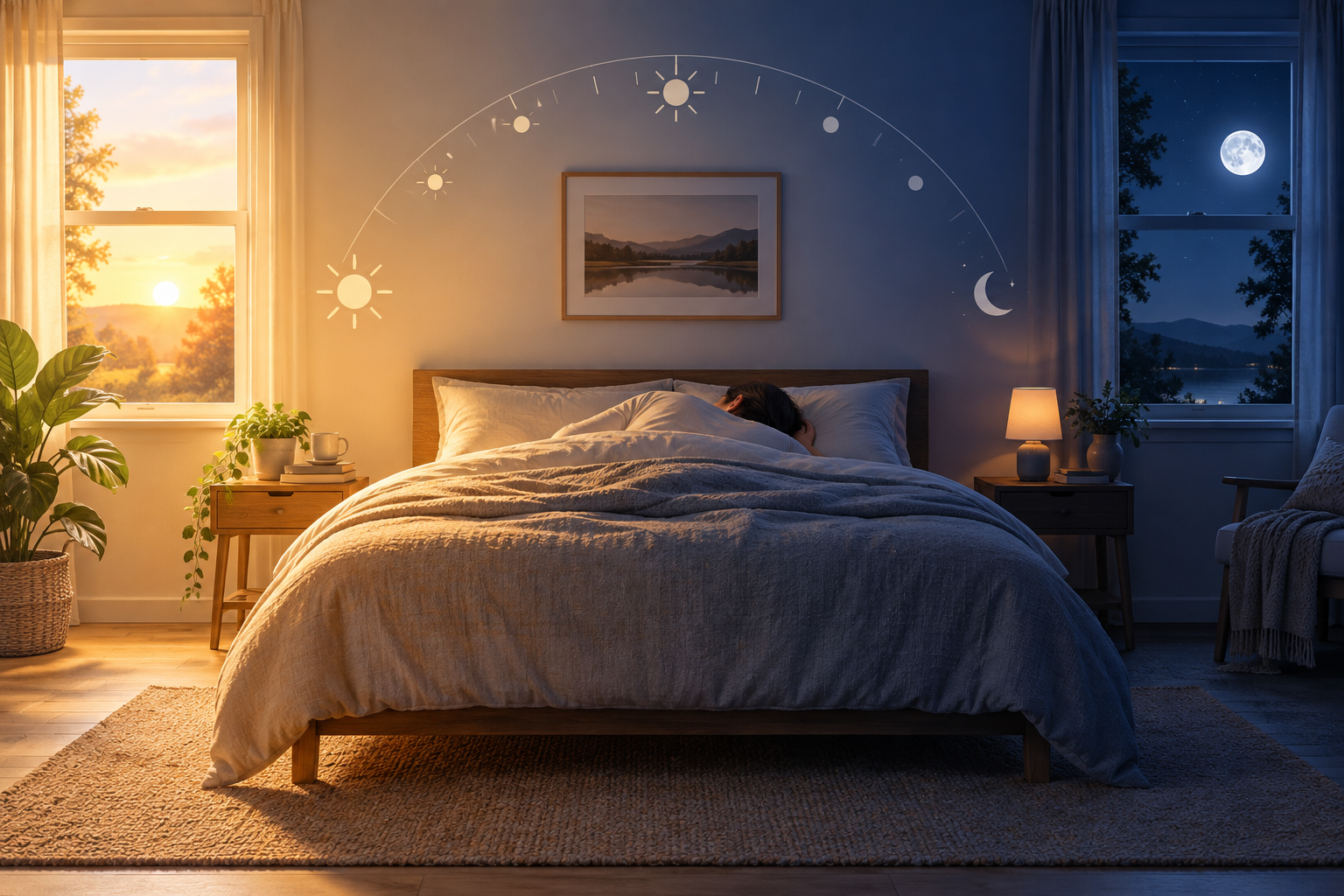
The SCN uses light to keep time
A tiny group of cells in the brain called the suprachiasmatic nucleus, or SCN, acts as the body's central timekeeper. Light detected by the eyes helps the SCN align internal rhythms with day and night.
As evening darkness arrives, melatonin usually rises and helps signal biological night. Morning light helps reset timing and supports alertness. Cortisol also follows a daily rhythm and commonly rises toward morning; it is not simply an on-and-off opposite of melatonin.
Two forces shape your sleep window
Process S, sleep pressure: builds the longer you are awake, then eases while you sleep.
Process C, circadian timing: provides changing signals for alertness and sleep across roughly 24 hours.
When sleep pressure is high and the circadian wake signal falls in the evening, sleep usually comes more easily. A late nap, bright light at night, shift work or travel across time zones can alter that balance.
A simplified teaching diagram, not a personal measurement.
Are you more lark, owl or somewhere between?
Chronotype means your natural preference for earlier or later sleep and activity. It is a continuum, not three fixed personality types. Genetics contribute, while age, light exposure, routines and obligations also shape when you actually sleep.
A night is made of repeating sleep cycles
You move through three non-REM stages and REM sleep several times. A cycle commonly lasts about 80 to 100 minutes, with four to six cycles in a typical night. Deep sleep is usually concentrated earlier; REM periods generally grow longer toward morning.
Sleep changes from hour to hour
This chart shows the overall pattern, not a score to chase. Real nights vary by person, age, health and circumstances.
Transition to sleep
The lightest stage. Muscles relax, awareness of the room fades and you may wake easily.
Established sleep
Heart rate and breathing settle, body temperature drops and you become less aware of your surroundings.
Deep sleep
Also called slow-wave sleep. It is harder to wake from and tends to be more abundant in the first part of the night.
Active dreaming sleep
Brain activity rises, the eyes move rapidly and vivid dreams are common. REM periods usually lengthen later in the night.
Your dreaming brain is active throughout the night
Dreams can occur in every stage of sleep, although they are usually most vivid during REM. You may spend around two hours dreaming across a night and remember only a small part of it.
Often quieter and more thought-like
Dream experiences can be brief, fragmentary or connected to ordinary concerns. This does not mean that non-REM sleep is dreamless.
Often vivid, emotional and story-like
The brain is highly active while most limb muscles become temporarily relaxed, helping prevent ordinary dream movements from being acted out.
Why morning dreams can feel memorable: REM periods tend to grow longer later in the night. Waking during or just after one gives the dream less time to fade before you become fully alert.
Why do we dream? There is no single proven answer. Researchers study possible roles in emotion and memory processing, but the exact purpose remains uncertain.
Do not grade every night: consumer watches estimate sleep stages rather than measuring them like a clinical sleep study. How you feel and function matters more than trying to perfect every number.
Build a wind-down runway
Your routine does not need to be elaborate. Repeating a few calm cues at roughly the same time can help separate the active day from the sleeping night.
Let the day soften
Finish heavy meals where practical and turn the pace down gradually.
Reduce bright screens
Put work and scrolling aside. Dim the room and choose a calmer activity.
Repeat a quiet cue
Read, listen to gentle audio, breathe slowly or write tomorrow's tasks down.
Go when sleepy
Keep the room dark, quiet and comfortably cool. Avoid forcing sleep.

A routine only works if it fits real life
Choose two or three repeatable signals rather than designing a perfect ritual you cannot maintain. A consistent wake time, dimmer light and ten quiet minutes may be enough to begin.
- Keep bedtime and waking time broadly regular
- Try putting phones, tablets and computers away for the last hour
- Move worries onto paper before getting into bed
- Save stimulating work and difficult conversations for earlier when possible
A room that quietly says “sleep”
Your bedroom cannot guarantee sleep, but it can remove common obstacles. Aim for improvement rather than perfection.
Caffeine
Tea, coffee, cola and energy drinks can keep you alert. Notice how late-day caffeine affects you and move it earlier if needed.
Alcohol & nicotine
Alcohol may feel sedating at first but can disturb sleep later. Nicotine is a stimulant. Cutting down can help sleep as well as general health.
Daytime movement
Regular activity can support sleep. If vigorous late exercise leaves you alert, move it earlier and keep evenings gentler.
The ChronoWaves guide to better sleep
Our one-minute illustrated guide brings the essential sleep habits together in one calm, practical checklist.
Simple changes for a better night
An original narrated ChronoWaves video covering practical ways to prepare your body, mind and room for sleep. It will not autoplay.

Let the chart inspire reflection
Sleep is deeply personal, and many people naturally notice recurring patterns in their energy, mood and dreams. Like numerology, horoscopes, feng shui or tarot cards, a biorhythm chart can give shape to a feeling and inspire thoughtful questions about how you slept and how you feel today.
Physical: How rested or heavy does your body feel today?
Emotional: How settled, sensitive or resilient do you feel?
Intellectual: How easy is it to focus, plan or solve problems?
Compare those observations with sleep duration, bedtime, waking time and daytime habits. Your own notes are evidence about your experience; the biorhythm curve is simply another lens for curiosity.
Know when to ask for support
Speak to a GP when:
- sleep problems have lasted for months
- changing your habits has not helped
- poor sleep is making daily life hard to cope with
- you are worried about snoring, breathing pauses, unusual movements or severe daytime sleepiness
If you cannot sleep
Do not battle with it. If you have been awake for a while, get up, sit somewhere comfortable and do something quiet. Return to bed when you feel sleepier.
For persistent insomnia and treatment information, see NHS: Insomnia .