 ChronoWaves
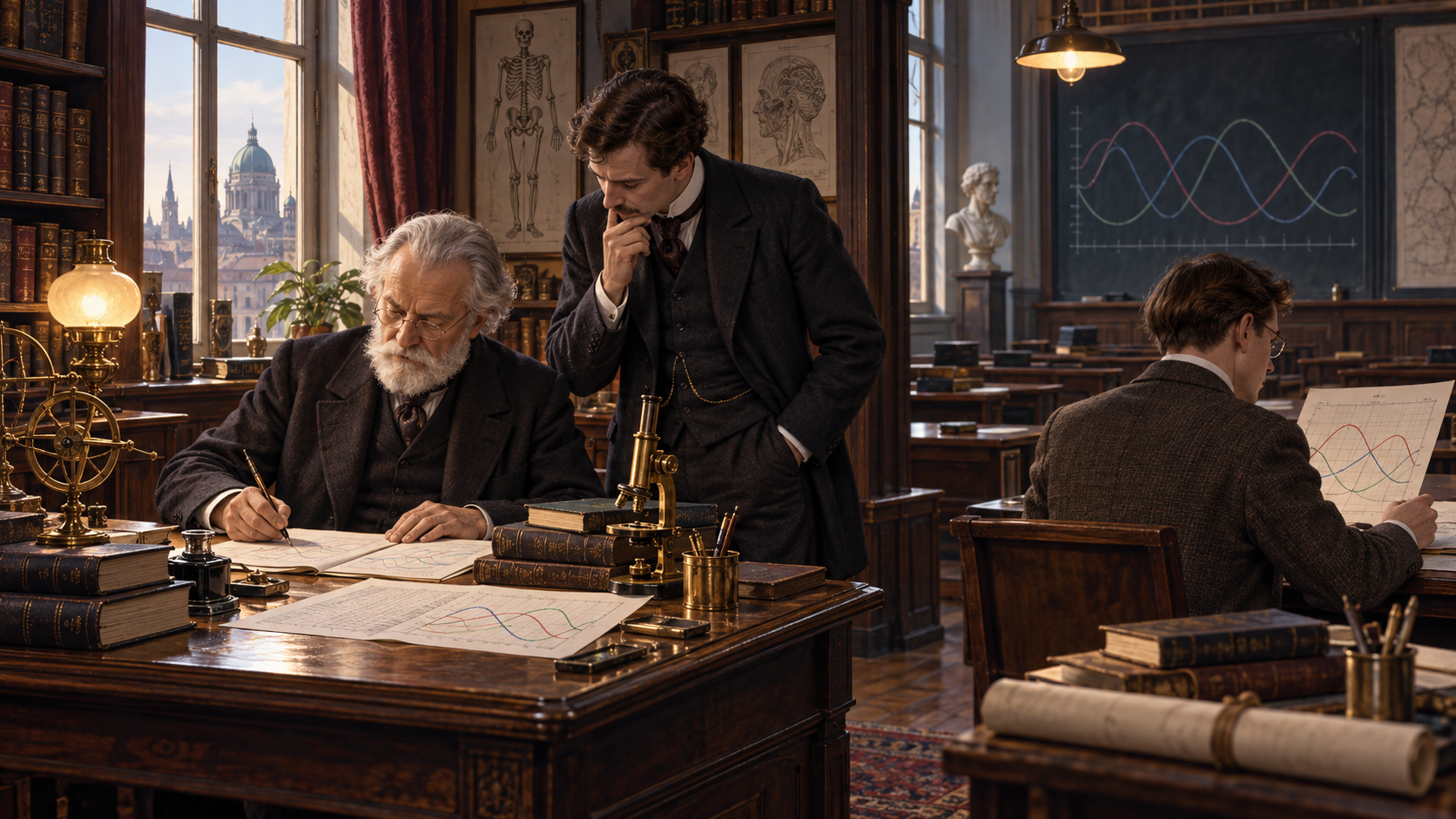
History of Biorhythms
How observations, numerology and a search for hidden patterns became the familiar 23, 28 and 33-day model.
Begin in the 1890sAn intriguing idea that still invites curiosity
Classic biorhythm theory grew from attempts to find numerical patterns in health, mood and performance. Its story continues because people are naturally drawn to cycles, coincidence, meaningful numbers and the possibility that life may contain patterns waiting to be noticed.
The story in a few minutes
Biorhythm theory is a late 19th-century numerical tradition proposing that human lives follow repeating mathematical cycles of 23, 28 and 33 days.
Origins in the late 19th century
- Physical and emotional cycles: Wilhelm Fliess proposed recurring 23 and 28-day periods in the late 1890s. Later popular accounts labelled them physical and emotional cycles.
- Independent observations: Hermann Swoboda published similar ideas in Vienna and became associated with the theory’s recurring transition points or “critical days”.
- The intellectual cycle: Later accounts credit Alfred Teltscher with adding a 33-day cycle after observing student performance, although the original research is difficult to verify.
The 1970s popularity boom
- Commercialisation: Books, personal chart services and dedicated calculators turned the theory into a wellness craze.
- Mainstream visibility: Charts appeared in amusement machines and early computer software, while some organisations explored scheduling people around the transition points known as critical days.
Meaning and modern context
- A different lens: Chronobiology observes bodily rhythms, while classic biorhythms create a personal mathematical pattern from a birth date.
- Personal discovery: Many enthusiasts compare the curves with diaries, memories and everyday experience to notice connections of their own.
- Meaningful symbols: Personal symbols can inspire confidence or reflection. Taylor Swift was born on 13 December 1989 and turned 13 on Friday the 13th. She has also highlighted that her first album went gold in 13 weeks and her first number-one song had a 13-second introduction. In her early career, she even drew 13 on her hand before performances. What many people regard as unlucky became her favourite number and a positive part of her story.
Further exploration
For deeper reading, explore the recent historical analysis, early books and archive material, then use Wikipedia as a convenient route to additional references.
The people associated with the classic model
Wilhelm Fliess
Physician and correspondent of Sigmund Freud
Fliess looked for repeating intervals in illness, recovery, births and deaths. He proposed recurring periods of 23 days and 28 days, which he described using the gendered language of his era as “male” and “female”. Later popular accounts recast these as the physical and emotional cycles.
Hermann Swoboda
Psychologist and university lecturer
Swoboda studied recurrence in thoughts, dreams and behaviour and published Die Perioden des menschlichen Organismus in 1904. He also discussed 23 and 28-day periods. Fliess later accused Swoboda of taking his ideas, creating a public priority dispute around the theory.
Alfred Teltscher
Engineering teacher commonly linked to the third cycle
Later biorhythm literature credits Teltscher with proposing a 33-day intellectual cycle after examining fluctuations in students’ academic performance. This story is repeated widely, but a clear original published study is difficult to trace, so it should be presented as an attribution rather than a firmly documented experiment.
Three waves, all starting at birth
The familiar version treats birth as day zero and plots every cycle as a sine wave. Over time, people gave the curves the physical, emotional and intellectual meanings shown below, creating the classic language still used today.
Where did the extended rhythms come from?
The extended cycles arrived much later than the classic model. Their story is still being uncovered, adding another layer of mystery to the way the wider seven-cycle tradition developed.
Mort Gale proposes a fourth, 38-day intuition cycle
Mort Gale’s book Biorhythm Compatibility presented a 38-day “intuition” cycle alongside the classic three. A later NASA technical review recorded Gale’s proposal and helped preserve this chapter in the development of extended biorhythm systems.
Intuition
The earliest extended cycle with a traceable printed source. Later chart makers associated it with instinct, subtle judgement and gut feeling.
Documented proposal: Mort Gale, 1978Aesthetic or Creative
Later systems added a cycle for artistic sensitivity, taste and expression. Modern calculators often rename “aesthetic” as the more approachable “creative” rhythm.
Origins: still being traced through later charting traditionsSelf-awareness or Awareness
This cycle appears in later expanded charts, with varying names and meanings centred on perception, perspective and noticing personal patterns.
Origins: still being traced through later charting traditionsSpiritual
The spiritual cycle belongs to still later holistic and New Age interpretations, where it is associated with reflection, purpose and inner steadiness.
Origins: still being traced through later charting traditionsHow the idea travelled
- Fliess develops his periodicity ideas
Medical observations, number patterns and correspondence with Freud form the early background.
- Swoboda and Fliess publish
Their books put the proposed 23 and 28-day periods into print and trigger a dispute over priority.
- The 33-day cycle enters the story
Later accounts associate Alfred Teltscher with an intellectual or mental-performance rhythm.
- A mass-market revival
Popular books, printed charts and inexpensive electronics turn biorhythms into an international craze.
- Casio releases the H-801 Biolator
A date of birth and target date could now produce a pocket-sized biorhythm reading.
- The first clearly documented extended cycle
Mort Gale publishes a proposed 38-day intuition cycle. Other extended periods become common later, but their precise origins are difficult to verify.
- The idea finds new digital life
Home computers, websites and mobile tools make personal charts easier to explore, while the curves continue as symbols of curiosity and reflection.
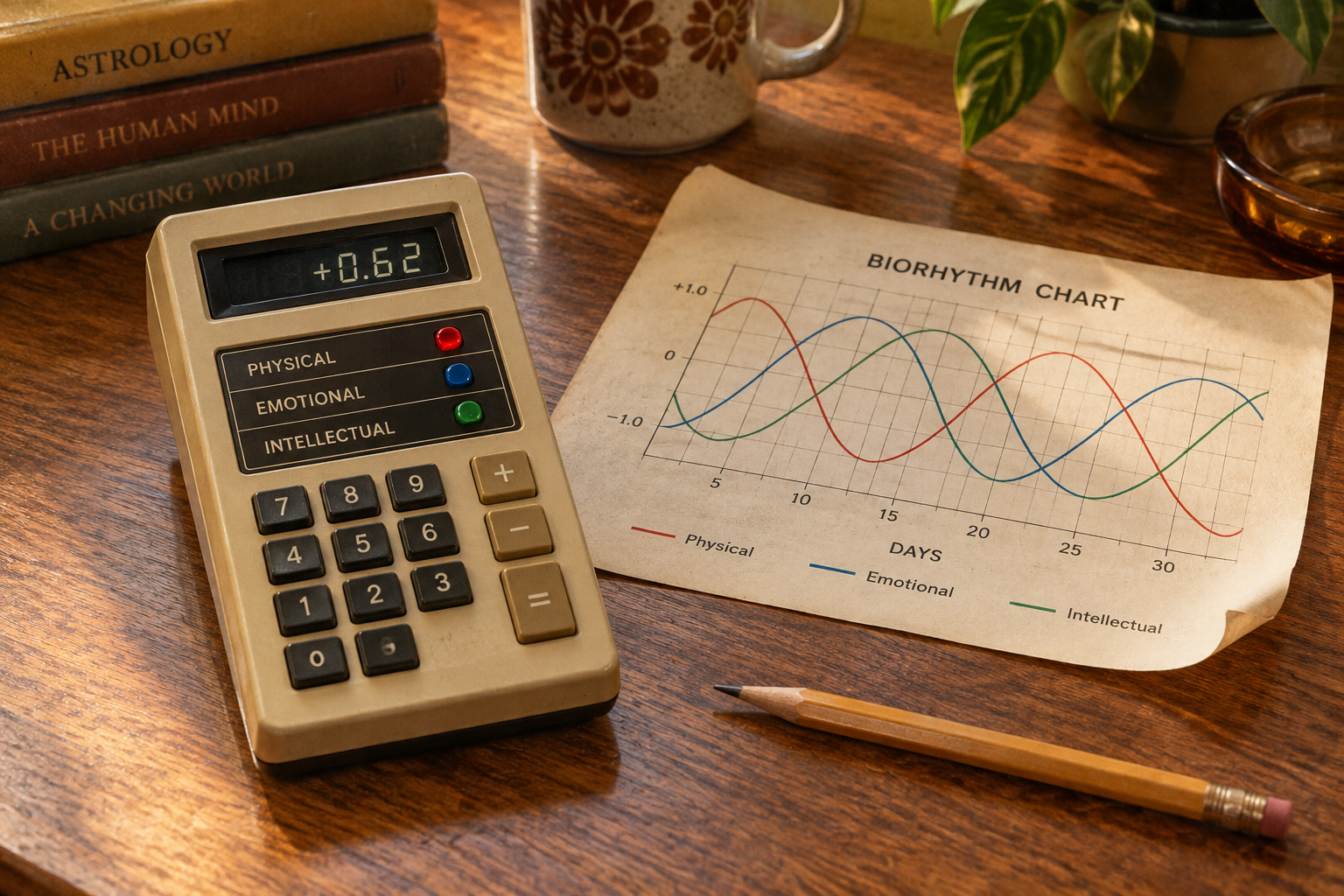
When the waves became a product
Biorhythm charts appeared in books, newspapers, amusement machines, calculators and early personal-computer software. The appeal was easy to understand: enter a birth date and receive a personalised-looking forecast.
Casio’s official history records its H-801 Biolator in 1975, while surviving Kosmos 1 calculators show how the theory became part of everyday consumer technology.
A mathematical story with lasting human appeal
An enduring fascination
People across generations have been drawn to cycles, meaningful numbers and repeating patterns. Classic biorhythms offer a simple visual language for exploring those personal connections.
NASA preserved part of the story
A NASA technical review traced the history and recorded proposed uses in aviation and human performance, creating a valuable archive of the idea’s reach during its popularity.
Two ways to explore rhythm
Chronobiology studies rhythms influenced by light, physiology and environment; classic biorhythms offer birth-date mathematics, visual patterns and a personal invitation to reflect.
As cultural history, elegant mathematical visualisation and a light, enjoyable prompt for personal reflection.